
In Web3, every technical hire changes the security posture of the company....
The Security Risk Behind Every Web3 Hire

TL;DR
In Web3, every technical hire changes the security posture of the company. The question is not only whether someone can build, but what level of trust the organization is about to place near code, access, infrastructure, and value.
Most teams think about security after the hire.
They think about audits, bug bounties, multisigs, access controls, monitoring, incident response, and key management. All of those matter. But in Web3, security begins much earlier than the audit report. It begins when a company decides who is allowed into the system.
That is why hiring needs to be treated as a security function.
A developer joining a Web3 company may eventually touch smart contracts, backend infrastructure, deployment flows, private repositories, admin panels, data pipelines, protocol documentation, wallets, or cloud environments. Even if they never directly control funds, they can still influence the systems that protect them. Their judgment becomes part of the company’s risk model.
This is where Web3 hiring becomes different from ordinary technical hiring.
In a normal software company, a weak hire may slow delivery, create bugs, or increase technical debt. In Web3, the same weakness can create financial exposure. A missed assumption, a poor review, an unclear access boundary, or a rushed deployment can become expensive very quickly.
The industry already knows how costly security failure can be. Chainalysis reported that stolen crypto funds rose to around $2.2 billion in 2024, with hacking incidents increasing from 282 in 2023 to 303 in 2024. By mid-2025, Chainalysis reported that more than $2.17 billion had already been stolen from cryptocurrency services that year, driven heavily by major service breaches and private key compromise. Chainalysis 2024 hacking report Chainalysis 2025 mid-year update
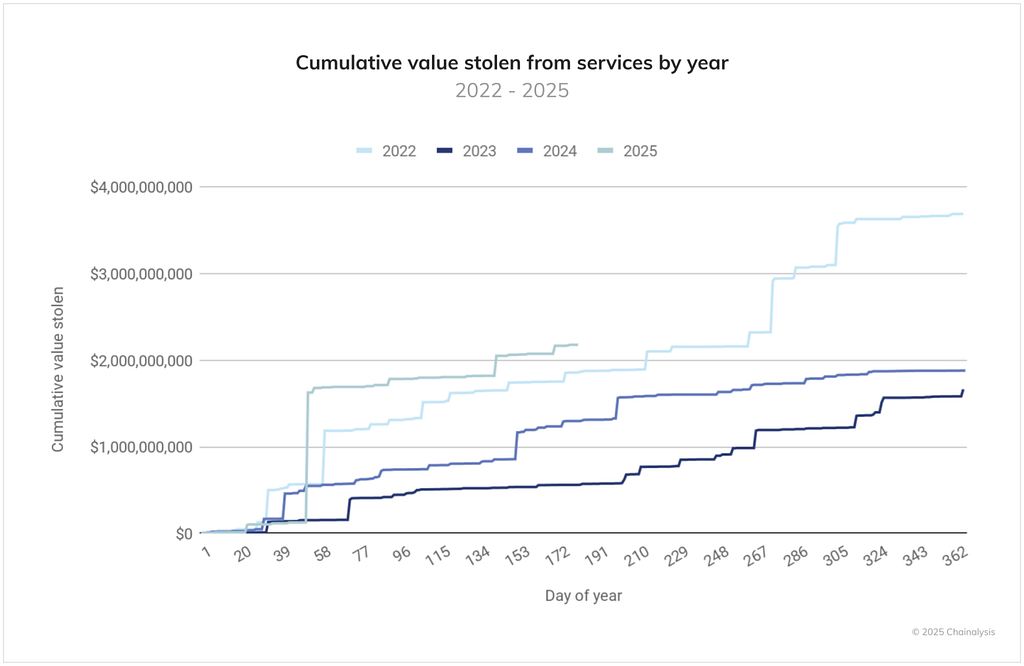
Those numbers are usually discussed as cybersecurity failures. They should also force a hiring conversation.
Because security is not only a tooling problem. It is a people problem, a process problem, and a trust problem.
The strongest Web3 teams understand this. They do not treat recruitment as a pipeline for filling seats. They treat it as a filtering system for risk. Before someone receives access, authority, or influence, the company needs to understand how that person thinks. Not just what languages they know. Not just what projects they list. Not just whether they can speak confidently in an interview.
A strong technical hire should be able to reason about trade-offs. They should understand how systems fail. They should ask what happens when an oracle behaves unexpectedly, when a private key is compromised, when governance authority is too concentrated, when a deployment process depends on one person, or when a clean-looking implementation changes the risk profile of the product.
That kind of thinking is not always visible on a CV.
This is why surface-level hiring is dangerous in Web3. A candidate can have the right keywords, a polished GitHub, and enough vocabulary to pass a shallow conversation. None of that proves they can operate safely inside a high-stakes technical environment. The real question is whether their judgment is strong enough for the level of access and responsibility the company is preparing to give them.
The Munchables exploit made this risk impossible to ignore. In 2024, the Blast-based Web3 game lost around $62 million before the funds were returned. Reports described the incident as involving a developer connected to the project, and later coverage said Munchables would change how developer hiring was overseen after the exploit. The Block CCN
The lesson is not simply that smart contracts need better controls. The deeper lesson is that trust given too early can become an attack surface.
This matters even when the risk is not malicious. Most bad hiring outcomes are not dramatic insider attacks. Often, the damage is slower and quieter. A weak engineer lowers the quality of code review. A poor technical lead makes fragile architectural decisions. A team hires for speed, then spends months carrying the hidden cost of people who were never properly verified. Senior engineers become the safety net, review culture becomes weaker, and the system becomes harder to reason about.
From the outside, the team may look bigger. Internally, it may have become less secure.
Headcount can create a false sense of progress. A company hires three engineers and assumes capacity has increased. But if those hires require constant correction, the senior team may now have less real capacity than before. The best people spend more time reviewing basic mistakes, explaining obvious risks, and protecting the codebase from avoidable problems.
That is not scaling. That is risk transfer.
Web3 companies need to be especially careful because technical density matters more when the systems are complex and adversarial. A protocol is not just a product. It can hold value, route assets, integrate with other protocols, depend on governance decisions, and operate in an environment where attackers have strong financial incentives. In that context, every weak technical decision has a larger blast radius.
Hiring also intersects directly with identity risk.
Government agencies have repeatedly warned that North Korean IT workers use false identities to obtain remote technology work, including roles that can provide access to company systems. The FBI has warned businesses about North Korean IT worker threats, including cases involving data extortion, while the U.S. Department of Justice announced coordinated action in 2025 against schemes involving fraudulent remote IT work, seized infrastructure, and company infiltration. FBI U.S. Department of Justice
That does not mean every Web3 company should become paranoid. It means the hiring process must be mature enough for the threat environment it operates in.
Remote work is normal in Web3. Global hiring is normal. Pseudonymous communities are normal. Open-source contribution is normal. These can be strengths, but they also create room for identity gaps, access mistakes, and overconfidence. A company that hires globally without strong verification is not being open-minded. It is leaving part of its security model undefined.
Technical verification should therefore go beyond a coding test.
A real hiring process should examine how someone reviews unfamiliar code, explains system design choices, handles ambiguity, communicates risk, and responds when their assumptions are challenged. It should include deeper review for roles that touch contracts, infrastructure, wallets, security, DevOps, backend systems, or privileged internal tools. The more access a role receives, the stronger the verification should be.
This is not about slowing hiring down for the sake of process. It is about avoiding expensive speed.
Fast hiring feels efficient when the company is under pressure. A roadmap is late, a launch is close, or the founder needs more engineers yesterday. But weak verification creates a debt that gets paid later by the strongest people on the team. They absorb the risk through extra reviews, rewrites, emergency fixes, and constant context correction.
In Web3, that debt can become a security liability.
The best companies make trust gradual. They do not give broad access just because someone has signed a contract. They start with clear boundaries, limited permissions, structured onboarding, peer review, and observable work. Trust grows through evidence. It is earned through consistency, judgment, communication, and technical depth.
That principle should shape both recruitment and internal access.
A candidate should not be evaluated only for whether they can complete tasks. They should be evaluated for whether they can be trusted with the type of responsibility the company is actually hiring for. A smart contract engineer needs different scrutiny from a frontend contributor. A DevOps hire with access to deployment infrastructure needs different checks from a content contributor. A technical lead who will influence architecture needs deeper evaluation than someone joining for a narrow implementation role.
Different roles carry different risk.
Hiring should reflect that.
This is where many companies need to mature. They want elite Web3 engineers, but their hiring process still looks like generic tech recruitment. A recruiter screens for keywords. A hiring manager asks about previous projects. A short technical task checks basic competence. Then the company makes a decision based on speed, availability, and confidence.
That may work for low-risk roles. It is not enough for teams building systems connected to real value.
Web3 hiring needs stronger technical evidence. Real code review. Architecture discussion. Security reasoning. Reference depth. Identity confidence. Clear access planning. Better understanding of how a person will interact with the systems, people, and decisions around them.
A good hire improves the company’s security culture. They ask sharper questions. They make code review stronger. They reduce pressure on senior engineers instead of adding to it. They understand why certain shortcuts are dangerous. They make the team more capable of finding problems before attackers do.
A bad hire does the opposite. Sometimes through malicious intent, but more often through weak judgment.
That is why hiring belongs in the security conversation.
Not as an HR slogan. Not as a dramatic warning. As a practical operating principle for Web3 companies that want to protect what they are building.
The people you hire will shape the codebase. They will shape the review culture. They will shape the access model. They will shape how risk is discussed, escalated, ignored, or solved.
In Web3, that means they will shape security.
Who We Are
Veretin Recruitment is a specialist Web3 recruitment company. We believe in quality over quantity, manual talent filtering, and one-to-one client relationships. We do not rely on job boards or automated CV spam. Our process is built on technical rigor, live code reviews, and deep verification of candidate capability.
We help Web3 founders, CTOs, and protocol teams find the technical operators required to build secure, high-performing systems.
Originally published on Medium